
.JPG)
| Identification / पहचान | |
| Reference Number / संदर्भ संख्या | JK02002280 |
| Built Heritage/Site निर्मित धरोहर / स्थल |
Built Heritage |
| Name of the Monument / Built Heritage / Site स्मारक / निर्मित धरोहर / स्थल का नाम |
Shrine of Janbaz Wali |
| State / राज्य | Jammu and Kashmir |
| District / जिला | Baramula |
| Manual District | |
| Sub District / उप-जिला | Baramula (TC) |
| Manual Sub District | |
| Village / गाँव | |
| Manual Village | |
| Cultural Affiliation / सांस्कृतिक सम्बंधन | Modern - आधुनिक काल |
| Date/Period तारीख/युग |
C. 19th - 20th Cent. CE |
| Sub Period | |
| Geo-Location / भू-अवस्थिति | Janbazpora |
| Latitude / अक्षांश | 34 13 11 |
| Longitude / देशान्तर | 74 21 48 |
| Approach to the Monument / पहुंचने का मार्ग | |
| Approach /पहुंचने का मार्ग | |
| Air Port / विमानपत्तन | Srinagar |
| Railway Station / रेलवे स्टेशन | Baramulla |
| Bus Station / बस स्टैंड | Baramulla |
| Topographical Features / स्थलाकृतिक विशेषताएं | |
| Topographical Feature / स्थलाकृतिक विशेषताएं | Hill - पहाड़ी |
| Topographical Description / स्थलाकृतिक विवरण | The shrine is located on the left bank of the river Jhelum on the main Baramulla-Uri road, just outside the main town of Baramulla in the area called Janbazpora, after the name of the saint. The shrine lies within a large open ground which also includes a graveyard. The area is richly vegetated but plain and the complex itself has a number of mature chinar trees. |
| History / इतिहास | |
| Brief History / संक्षिप्त इतिहास | ayyed Mohammed Rufai popularly known Shah Janbaz wali has also been referred to as Sayyed Mohammed Isfahani in some of the historical records of Kashmir. Sayyed Mohammed flourished in the 15th century during the reign of Sultan Zain-u-abidden. A recluse by nature, Janbaz wali migrated from the city to Baramulla along with his family to avoid meeting with people. The area which he selected for his meditation was a pasture in the vicinity of forest and the river Jhelum. The sultan is said to have been a great admirer of Janbaz wali and also made some denotations for the maintenance of his langar khana public kitchen . On his death Janbaz wali was buried in his place of meditation and the area became famous by the name of Janbazpora. |
| Local / Traditional description associated with Built Heritage / Site निर्मित धरोहर / स्थल से सम्बंधित स्थानीय/ परम्परागत विवरण |
Like the historic town of Srinagar, Baramulla is yet another significant town located on the banks of River Jhelum. The principal occupation of the people for many generations has been that of fruit business and therefore the area around the town is seen dotted with many sprawling apple orchards. A number of significant religious places for both Hindus and Muslims are seen in and around the town. |
| Architectural Style / स्थापत्य शैली | Vernacular- क्षत्रीय |
| Building/ Structure/Site
इमारत / संरचना / स्थल |
|
| Description of Building/ Structure/Site
इमारत/संरचना/स्थल का विवरण |
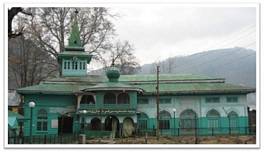
The shrine of Janbaz wali comprises of two separate buildings with a passage in between serving as the langar kahna .The buildings area aligned along the north-south axis and consist of the shrine proper north and the mosque south . The southern block comprising the mosque 25ft. x 35ft. approx is rotated slightly to the south on account of the qibla. Internally the ceiling is supported on four wooden columns, dividing the entire block into a module of 9 units. The main entrance to the mosque is from a door located on the north-eastern corner of the eastern faced, while another smaller door is located on the south-eastern corner of the southern fa ade. The ceiling of this block is made of khatamband and the mehrab comprises an interesting pattern of raised and moulded mud plaster work which has been painted over. The shrine of the saint comprises of a single storey block 40ft.x30ft. approx , essentially comprising of the screened central chamber containing the cenotaph s surrounded by an inner circumambulatory and an outer ambulatory space, a unique feature of the shrine. The entrance to the shrine is from a centrally located doorway on the southern side. The buildings retains many of its original decorative features including the geometric motifs carved on the wall paneling, pinjrakari etc. A dalan in form of a entrance gateway has been added on the eastern end of the passage, while a room has been added on the western end. The mosque walls comprise wooden blocks used as header and stretchers, while the outer walls of the shrine are in masonry and seem to be a latter day addition. The entire structure is covered under a single two tiered roof, with the mosque having the traditional pavilion and spire. |
| Structure material and other material संरचनागत सामग्री और अन्य घटक |
|
| Building/Structure material and other material used प्रयोग में लाई गई इमारती / संरचनागत सामग्री और अन्य घटक |
The walls are constructed in wooden blocks with masonry infill as well as brick masonry. The flooring is in PCC as well as in mud. The building consists of pointed arched window openings infilled with pinjrakari work. The ceiling is in khatamband pattern. The building is covered with two tier hipped roof surmounted by a square pavilion with a spire at the extreme left side. The most distinct features of the building are pinjrakari, carved eaves board, pendents, carved architrave, naqashi work and brackets. |
| Usage(s) & Sub Type | |
| Usage(s) / प्रयोग | |
| Sub-Usage(s)/ उप-प्रयोग | Religious |
| Ownership / स्वामित्व | Waqf Board - वक्फ बोर्ड |
| Protection status / संरक्षण अवस्था | Unprotected- असंरक्षित |
| Plan/Elevation विन्यास/उध्र्व विन्यास | |
| Published Reference / प्रकाशित संदर्भ | |
| Author / लेखक | |
| Name / नाम | |
| Year / वर्ष | |
| Published/Unpublished प्रकाशित / अप्रकाशित |
|

| © Disclaimer:NMMA may be contacted for any further information. The documented data is under correction and subject to validation. |