




| Identification | |
| Name of the Museum /Institution
संग्रहालय/संस्था का नाम |
Directorate of Assam |
| Reference Number / संदर्भ संख्या | SM-DAS-AM-1404367 |
| Title/ Name of Object वस्तु का शीर्षक/नाम |
Decorative block |
| Type of Object / वस्तु की किस्म | Architectural Remains - स्थापत्य अवशेष |
| Dynasty /वंश | Pre-Ahom - पूर्व अहोम काल |
| Period / तारीख/युग | C. 10th 12th Cent. CE |
| Style / शैली | Old Assamese Style - प्राचीन असामी शैली |
| Provenance / उद्गम/क्षेत्र | Deoparbat, Golaghat, Assam |
| Material / सामग्री | Granite- ग्रेनाइट |
| Sub Material / उप.सामग्री | |
| Location at the Museum / संग्रहालय में कहा पर अवस्थित है। | at the main site |
| State/UT राज्य/संघ राज्य क्षेत्र |
Assam |
| Measurement/Weight माप/वजन |
|
| Length(cm) / लंबाई | . |
| Width(cm) / चौड़ाई | 98.3 |
| Height(cm) / ऊंचाई | 86.5 |
| Weight(gm) / भार | . |
| Diameter(cm) /व्यास | . |
| Thickness(cm)/मोटाई | 42.5 |
| Depth(cm) /गहराई | . |
| Description / विवरण | |
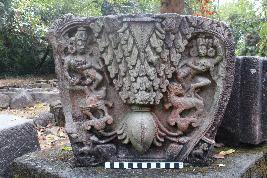
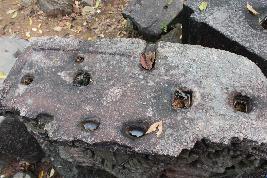
| Description / विवरण | It is an upturned conical-shaped architectural block. The designs are carved on the frontal. There are four shallow square-shaped depressions aligned in a horizontal pattern at the top and few oval-shaped shallow depressions There are carvings of sophisticated designs and human figurines made at the frontal. There is an upturned intricately carved half-bloom lotus in a mid-relief reaching the elevated platform of the base. There are two extended lotus buds and two full bloom lotuses carvings which formed platforms on either side for two miniature caparisoned lion and bull. From the looks of it, the upturned lotus appears to be attached to a stylized open mouth which has its tongue sticking out and visible fangs on either side, along with a row of square-shaped teeth. The unfurled coils indicate a fire flare or stylized beard. The V-shape then continue to get narrower around the border and alters to floral petals. There are two figurines, a male and a female, in a low relief. The figure to the left is shown to be mounted on the back of a heavily jewelled bull. The bull has a bell dangling around its neck. A single-string of rectangular beads hanging on its body and anklets (Nupura) carved on all four limbs. The figure mounted on top of it, is of a male and facing its left side. It is standing in a Tribhanga posture with an unidentifiable attribute on his right hand and the left hand folded closer to his chest. It is difficult to identify if there is any ayudha on his hand due to extreme weathering. The facial features are quite prominent. It has an aquiline nose with sharp jawline and beautifully carved eyebrow. The image is adorned with necklace (Kanthabhusana) covering his chest , circular earrings (kundalas), bangles (kankana) on both wrists and an extravagantly ornamented spiked headgear (Sirobhusana). The attribute (ayudha) on the additional left hand is distinguishable and is called Sula (battle axe) which is predominantly associated with Shiva . The long handle is made of wood that has a tri-pronged pike at top end. The image here could be of Shiva. He is wearing a long garland of severed human heads. The other figurine is of a female deity. She is shown mounted on top a lion standing in a tribhanga posture. The female has four hands and each of them is holding an attribute (ayudha).From left to right, the deity is shown holding an unidentifiable attribute with the additional left hand, the other arm is broken completely. She is shown carrying a beaded bracelet with her right hand which is folded closer to her chest. In the additional arm, she is shown holding a small drum (Damaru).She has an aquiline nose with distinct jawline and long eyebrows. She is adorned with circular earrings (Kundalas), heavily ornamented necklace (Kanthabhushana) covering her entire chest area, an embellished spiked headgear (Sirobhushana), bangles (Kankana) covering both the lower arms and, Nupura and Padajalaka on both the ankles. A sophisticated girdle around the waist can be noticed along with a long garland. A stylized garment with wavy design is shown to be worn by the figure covering the thigh area and a strand of fabric dangling in between the legs. The animal, lion, is an unconventional one. It has a short mane and is shown wearing a beaded necklace with a dangling bell. Its head is twisted back with his tongue sticking out. Both the figures are facing each other as if preparing for a duel. |
| Identification Marks / पहचान चिन्ह | |
| Identification Mark Images / पहचान चिन्ह का छायाचित्र | |
| Condition / वस्तु की अवस्था | |
| Condition Description / स्थिति का विवरण | Gradual deterioration due to weathering. |
| Source | |
| From where acquired / अधिग्रहण का स्थान | Deoparbat Archaeological Site |

| © Disclaimer:NMMA may be contacted for any further information. The documented data is under correction and subject to validation. |